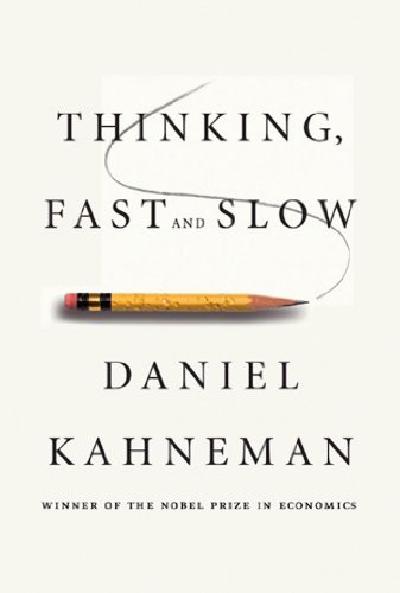
Okay, let’s talk about Thinking, Fast and Slow. If you’ve ever wondered why you make a decision and then, five minutes later, realize it was a total disaster, this book is for you. Reading this was basically like finding out that my brain is just a piece of buggy software that’s been running on “Auto-Pilot” my entire life.
The whole book is built around two systems in our heads. System 1 is the “Fast” brain. It’s intuitive, automatic, and effortless. It’s the part of you that knows 2+2=4 without thinking or can tell someone is angry just by looking at their face. System 2 is the “Slow” brain. It’s the logical, calculating part that you use when you’re doing your taxes or trying to figure out where to park a giant truck in a tiny space.
The problem? System 2 is lazy. Like, incredibly lazy. Most of the time, System 1 is the one driving the car, and System 2 is just in the passenger seat, asleep. We think we’re these rational, logical beings who weigh all the options before making a choice, but in reality, System 1 makes the choice in a fraction of a second, and then System 2 just comes along and makes up a story to justify it. We’re not logical; we’re just really good at pretending we are.
Then Kahneman gets into the “biases,” and this is where it gets genuinely unsettling. He shows us that our brains don’t just make random mistakes—they make the same mistakes over and over again.
Take “Loss Aversion.” This is the idea that losing something feels way worse than gaining something of the same value. If you find $20 on the street, you’re like, “Cool, free lunch!” But if you lose $20 out of your wallet, it ruins your whole day. Why? Because your brain is biologically wired to fear loss more than it values gain. It’s a leftover trait from our ancestors who had to prioritize “not dying” over “finding extra berries.” It’s wild to realize that my current mood could be dictated by a survival instinct from 50,000 years ago.
And then there’s “Anchoring.” This is the one that makes me feel like a sucker every time I go shopping. It’s when your brain latches onto the first number it sees. Like, if a store says a jacket is “originally $200, now $100,” your brain anchors to the $200, so the $100 feels like a steal—even if the jacket is actually only worth $40. Once you know how anchoring works, you start seeing it everywhere. It’s like you’ve suddenly seen the strings on the puppets of the marketing world.
The part that really messed with my head, though, was the “Two Selves” thing. Kahneman argues that we have an “Experiencing Self” (the one living in the moment) and a “Remembering Self” (the one that keeps the record). And here’s the kicker: we make all our decisions based on the Remembering Self.
He gives this example of a vacation. You could have a ten-day trip where nine days are just “okay” and the last day is an absolute blast. Your Experiencing Self had a mediocre trip. But your Remembering Self only cares about the “peak” and the “end,” so it labels the whole thing as a “great vacation.” We are essentially prisoners to our own faulty editing software. We don’t remember our lives; we remember the stories we told ourselves about our lives.
I’ll be honest: this book is a slog. It’s a total behemoth. It’s not a “beach read”—it’s more of a “sit in a quiet room and question your own sanity” read. The prose is very academic and dry. There are no stories or fancy metaphors; it’s just a relentless stream of experiments and data. It takes a lot of System 2 energy just to get through a single chapter. By the end, I felt like my brain had been through a workout.
But that’s why it’s so powerful. It’s not pop-psychology; it’s rigorous science. When Kahneman tells you that your intuition is wrong, he doesn’t just give you a quote from a guru; he shows you the data from a thousand people who all made the same mistake.
The Quick Rundown
What I loved:
- The “Aha!” moments. The realization that my brain is basically a glitchy app is strangely liberating.
- The practical insights. Knowing about loss aversion and anchoring actually helps me make better financial decisions.
- The intellectual rigor. It’s a book that doesn’t take shortcuts.
What I struggled with:
- The pacing. It is a very long, very dense book.
- The dryness. It can feel more like a textbook than a book.
- The existential dread. Realizing you’re not actually in control of your thoughts is a bit of a downer.
The Verdict: A life-altering piece of work. It’s the definitive guide to the glitches in the human operating system. It’s a challenging read, but it’s one of the few books that actually teaches you how to think, rather than what to think. If you’re okay with having your worldview shattered a few times, this is a must-read.