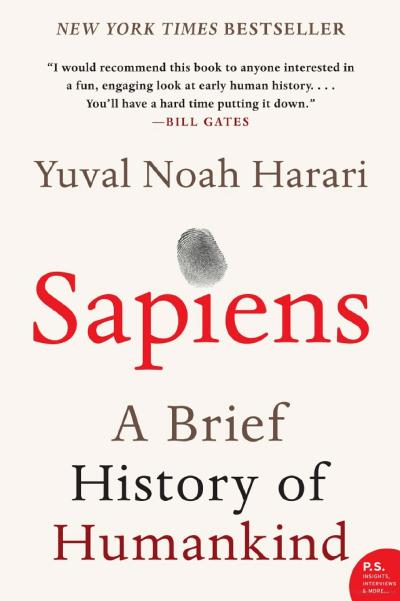
Okay, so I just finished Sapiens, and let me just tell you: my brain is officially melted. I feel like I just took a crash course in the entire history of the human race, and the main takeaway is that everything I thought I knew about reality is actually just a very convincing story we’ve all agreed to believe in.
The first thing that hits you is the perspective. Most history books are like, “And then this king did this, and then this war happened.” But Harari doesn’t care about kings or dates. He zooms way out. He starts with us as just another kind of ape—not even the strongest or smartest one, just some random primate in the middle of the food chain. It’s a humbling start. It’s like he’s saying, “Hey, you think you’re the center of the universe? You’re actually just a fancy monkey with a really good social network.”
And then he drops the big bomb: the “Shared Fictions.” This is the part of the book where my jaw actually dropped. He basically argues that the only reason humans conquered the planet is that we can imagine things that don’t exist. He says that things like money, laws, human rights, and corporations aren’t “real” in the way that a mountain or a tree is real. They’re just “inter-subjective” myths.
Think about a dollar bill. It’s literally just a piece of paper with some ink on it. If you showed it to a chimpanzee, he’d probably try to eat it. But because millions of humans all agree that it has value, it becomes a superpower. It’s the same with countries or religions. We’ve built this entire global civilization on a foundation of collective hallucinations. It sounds crazy when you put it that way, but when he explains it, it’s the only thing that makes sense. It’s like he’s showing you the code behind the Matrix of human society.
Then he hits you with the “Agricultural Revolution” part, and this is where the book gets really provocative. Most of us were taught in school that farming was a great leap forward—we stopped wandering around and started building cities and having art. But Harari says, “Actually, farming was the biggest scam in history.”
He argues that as hunter-gatherers, we had better diets, worked fewer hours, and were generally healthier and happier. Then we started farming, and suddenly we were tied to a tiny plot of land, working from dawn to dusk, and getting sick with new diseases because we were living too close to animals. But the real kicker? He says that wheat actually domesticated us. Wheat basically tricked humans into spending their entire lives clearing rocks and carrying water just so the wheat could spread its genes across the planet. I can’t tell you how many times I paused the book just to stare at the wall and think, “Wait, so I’m just a slave to a blade of grass?”
The last part of the book is where it gets a bit darker. He talks about the “hedonic treadmill”—the idea that no matter how much our technology improves, we aren’t actually any happier than we were 30,000 years ago. We have iPhones and medicine and air conditioning, but we’re still just the same anxious apes we’ve always been, just with better toys. It’s a bit of a depressing realization, but it’s also strangely comforting. It means that feeling stressed or unsatisfied isn’t a “modern” problem; it’s just how we’re wired.
In terms of the writing, Harari is a master of the “Aha!” moment. He has this way of taking a massive, complex concept from anthropology and boiling it down into one sentence that makes you feel like you’ve just unlocked a secret level of existence. The prose is clean and confident, and he doesn’t shy away from being bold or even a bit arrogant with his claims.
I will say, sometimes he’s too bold. He makes these huge, sweeping generalizations about the entire human species that a professional historian would probably have a heart attack over. He simplifies things for the sake of the narrative. But honestly? That’s why the book works. It’s not a textbook; it’s a conversation. It’s designed to make you question everything you take for granted.
The Quick Rundown
What I loved:
- The “brain-flip” moments. The shared fiction stuff completely changed how I look at the world.
- The “Wheat scam.” It’s a brilliant way to look at history from the opposite perspective.
- The scale. I love the feeling of zooming out from my own life to the history of the entire species.
- The provocations. It doesn’t just give you facts; it asks you “Why?”
What I struggled with:
- The over-simplification. Some of the “facts” feel a bit too convenient for the story.
- The bleak ending. The idea that we’re just “biological algorithms” is a bit of a downer.
The Verdict: A total mind-expander. Sapiens is one of those rare books that actually changes the way you perceive reality. It’s a provocative, daring, and slightly terrifying journey through the history of the human animal. If you want to feel both incredibly smart and completely insignificant at the same time, this is the book for you.