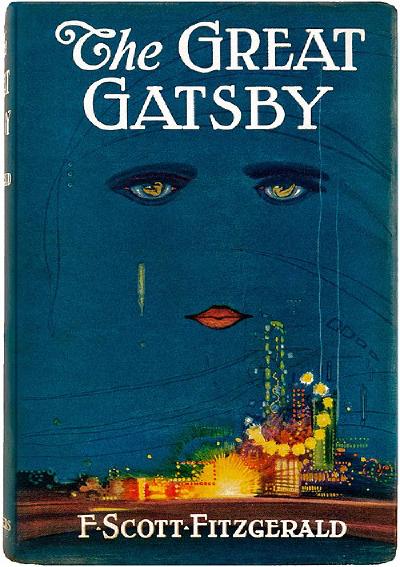
Okay, let’s talk about The Great Gatsby. I feel like everyone has a “relationship” with this book because we’re usually forced to read it in school. For a lot of people, that means they remember it as a boring chore about a guy in a suit. But reading it as an adult, without a teacher hovering over you asking about “symbolism,” it’s actually a total train wreck of a story—and I mean that in the best way possible.
First of all, the setting is just insane. The 1920s, the Jazz Age, the endless champagne, the parties where people just show up and dance with strangers. Fitzgerald describes the parties in a way that makes you feel the bass in your chest. It’s all gold and glitter and “yellow cocktail music.” But the whole time you’re reading it, there’s this nagging feeling that something is wrong. It’s like being at a party where everyone is smiling, but you can tell they all secretly hate each other.
And then there’s Gatsby. I have so many feelings about this man. On one hand, he’s an absolute legend—he built an empire from nothing just to impress one girl. On the other hand, he is the king of “trying too hard.” Everything about him is extra. His house is too big, his shirts are too fancy, his smile is a bit too perfect. He’s like that one guy who tries to impress everyone by talking about his crypto portfolio—you can tell he’s just pretending to be something he’s not. He’s “New Money” in the loudest way possible, and it’s kind of endearing and kind of cringe at the same time.
But the real tragedy isn’t the money; it’s the obsession. Gatsby doesn’t actually love Daisy; he loves the idea of Daisy from five years ago. He’s essentially in love with a ghost. He thinks that if he just gets enough money and a big enough mansion, he can literally press a “reset” button on time. I think we’ve all been there—that feeling where you’re convinced that if you just change one thing about your life, you can go back to that one perfect moment in the past. Gatsby just happens to have a few million dollars and a dock with a green light to help him do it.
Speaking of the green light… yeah, it’s the most famous symbol in the book, but if you think about it, it’s just a signal for “I’m not enough.” Gatsby spends the whole book staring at that light, convinced that once he reaches it, he’ll finally be happy. But the moment he actually gets Daisy back, the light doesn’t matter anymore. The reality of Daisy—who is, let’s be honest, kind of a nightmare—can’t possibly live up to the version of her he’s been polishing in his head for half a decade.
And that brings me to Daisy and Tom. Man, I cannot stand these people. Tom is exactly the kind of guy you just want to punch in the face—wealthy, arrogant, and just fundamentally cruel. And Daisy? She’s not just “passive”; she’s a coward. She likes the safety of Tom’s money more than she likes the passion of Gatsby’s love. The way they just “retreat back into their money” after causing a total disaster is the most infuriating part of the book. It’s a brutal reminder that some people are born with a shield that protects them from the consequences of their actions, while people like Gatsby (and Myrtle) just get crushed.
I also loved the “Valley of Ashes.” It’s this grey, depressing wasteland in the middle of all the glitz and glamour. It’s the part of the world the rich people forget exists, but it’s where all their trash—and their mistakes—end up. And that billboard with the eyes of Doctor T.J. Eckleburg? It’s like this silent, judging god watching over a world that has completely lost its mind. It adds this layer of gloom that keeps the book from feeling like a shallow party story.
The ending is, of course, a total gut-punch. Not because of the death, but because of how alone Gatsby is at the end. He threw the biggest parties in New York, and yet, when it actually mattered, almost no one showed up for him. He spent his whole life trying to be “one of them,” but he was always just a guest at someone else’s table.
Nick, the narrator, is the only one who actually gets it. He sees that Gatsby’s “extra-ness” was actually a form of purity—he was the only person in the book who actually believed in something bigger than himself. He had this incredible capacity for hope, even when the odds were zero.
The Quick Rundown
What I loved:
- The atmosphere. The “Jazz Age” vibe is perfectly captured.
- The social commentary. The “Old Money vs. New Money” struggle is still so relevant today.
- Gatsby’s tragic optimism. Even though it’s delusional, you can’t help but root for him.
- The prose. It’s just beautiful. Every sentence feels like it’s been carefully crafted.
What I struggled with:
- Daisy’s character. I know it’s intentional, but her lack of spine can be frustrating.
- The pacing. A few of the middle chapters feel a bit slow before the climax hits.
The Verdict: A shimmering, heartbreaking masterpiece. The Great Gatsby is a reminder that you can’t buy your way out of your past, and that the most dangerous thing in the world is a dream that refuses to die. It’s a quick read, but it leaves a huge mark. 10/10, would still feel bad for the guy with the green light.