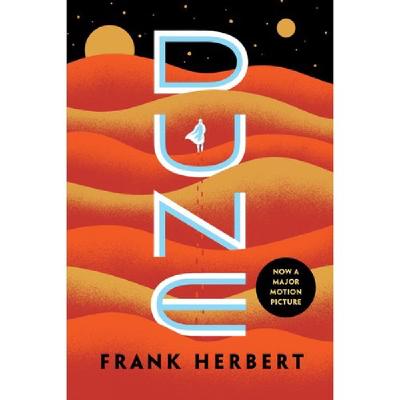
Okay, so I finally tackled Dune. Let me just start by saying: this book is a behemoth. Reading it is like trying to climb a mountain while carrying a suitcase full of dictionaries. It’s epic, it’s dense, and it’s absolutely wild.
The first thing that hits you isn’t the plot—it’s the thirst. Frank Herbert doesn’t just tell you the planet Arrakis is a desert; he makes you feel like you’re actually dehydrated. I found myself subconsciously reaching for my water bottle every few pages. The detail about the “stillsuits”—these suits that recycle every single drop of moisture from your body, including your sweat and… well, you know—is just peak sci-fi. Most stories give you a cool space suit and call it a day, but Dune tells you exactly how the plumbing works. It’s kind of gross, but in a way that makes the world feel incredibly real. It transforms the setting from a “cool backdrop” into a character that is actively trying to kill everyone.
Then there’s the “What on earth is happening?” phase. I’ll be honest: the first hundred pages were a struggle. Herbert just throws these weird words at you like he’s testing your IQ. “Bene Gesserit,” “Gom Jabbar,” “Kwisatz Haderach”… for a while, I felt like I was reading a textbook for a university course in a galaxy I’d never visited. I spent a lot of time flipping back to the glossary just to remember who was who and what a “Landsraad” even was. But here’s the thing: once it finally clicks, it’s like a light switch going on. You realize that the confusion is part of the experience. You’re feeling exactly what Paul feels as he’s thrown into this nightmare of a world.
Speaking of Paul… man, this guy’s life is a disaster. At first, you think, “Oh, cool, it’s a classic hero’s journey. Young prince goes to a new planet, becomes the leader of the locals, saves the day.” But as the book goes on, you realize that Dune is actually a warning against that kind of story.
Paul isn’t just a hero; he’s becoming a monster. He can see the future, and instead of it being a superpower, it’s more like a curse. He sees this “Golden Path” where he wins, but in the process, he sparks a galactic war that kills billions of people. Watching him struggle with that is the best part of the book. He’s not trying to save the world; he’s trying to figure out how to win without accidentally ending the universe. It totally flips the “Chosen One” trope on its head. It’s like the book is telling us, “Hey, if you ever meet someone who claims they are the prophesied savior of the people, run the other way as fast as you can.”
And then… the worms. I mean, come on. Giant sandworms the size of skyscrapers that eat anything that makes a rhythmic sound on the sand? Yes, please. The first time the scale of a Shai-Hulud is described, it’s genuinely breathtaking. I loved the way the Fremen treat them—not just as monsters, but as gods. The whole culture of the Fremen is just fascinating. They’ve turned survival into a religion. The way they value water as a currency is such a stark contrast to how we live. It makes you feel kind of guilty for how many times you’ve let the tap run while brushing your teeth.
If I have to complain about anything, it’s the dialogue. Some of the characters talk like they’re in a Shakespearean play or a very formal courtroom. No one in Dune ever just says, “Hey, what’s up?” It’s all “My lord” and “The Honorable House of Atreides” and these long, calculated speeches. At first, it felt a bit stiff, but then I realized that’s how the world works. Everyone is constantly playing a game of high-stakes chess with their words. One wrong syllable and your entire family gets executed. When you think about it that way, the stiffness makes total sense.
Overall, Dune is just a titan. It’s not a “light read.” You can’t just skim this book while you’re on the treadmill. It requires your full attention, but the payoff is huge. It’s a story about power, religion, and the environment that feels just as relevant today as it did when it was written.
The Quick Rundown
What I loved:
- The world-building. The stillsuits, the worms, the spice—everything feels so thought-out.
- The subversion of the “Chosen One” trope. Paul is a terrifying protagonist.
- The feeling of the desert. I genuinely felt thirsty while reading this.
- The political intrigue. It’s like Game of Thrones but with space-magic and giant worms.
What I struggled with:
- The learning curve. The terminology is a bit overwhelming at the start.
- The pacing. Some of the political meetings can drag on for a while.
- The formal dialogue. Occasionally felt a bit too “staged.”
The Verdict: An absolute masterpiece of sci-fi. It’s a challenging read, but it’s one of those books that actually changes how you think about power and destiny. If you’re tired of “cookie-cutter” space operas and want something that actually has some meat on its bones, Dune is the gold standard. Just remember to keep a glass of water nearby.