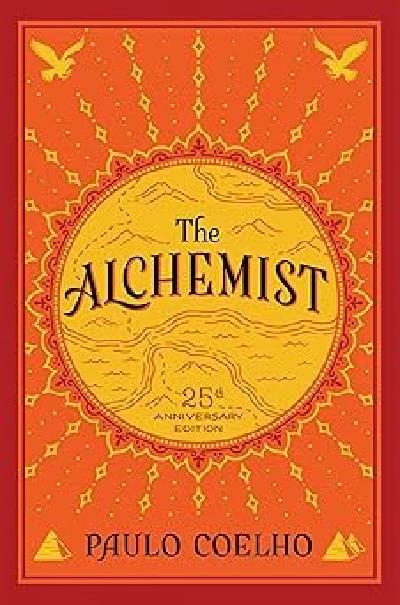
Okay, so The Alchemist. This is one of those books that you just cannot escape. It’s like the “Live, Laugh, Love” of the literary world. Everywhere I look—Instagram, BookTok, my aunt’s bedside table—this book is there. For the longest time, I resisted it because it felt too “spiritual” for me, and I have a bit of a reflex against anything that sounds like a motivational seminar. But eventually, I gave in. I figured, “Alright, why does everyone act like this book is a magical key to the universe?”
First off, the story is super simple. You’ve got Santiago, this shepherd boy who has a recurring dream about treasure at the pyramids in Egypt. Most people would just think, “Cool dream,” and go back to tending their sheep. But Santiago decides to actually go. And the whole book is basically just him walking from point A to point B, meeting different people, and learning “lessons” along the way.
Now, here is where I’m torn. On one hand, there’s something really cozy about the vibe of this book. I loved the imagery of the Spanish countryside, the heat of the desert, and the feeling of just… wandering. There’s a certain romanticism to the idea of leaving everything behind to chase a dream. It’s the kind of book you read on a rainy Sunday afternoon when you’re feeling a bit stuck in your own life and you just want to believe that there’s some grand destiny waiting for you. It’s a total “comfort read.”
But then, there’s the “Personal Legend” stuff. The book keeps hammering home this idea that you have a destiny and that “when you want something, all the universe conspires in helping you to achieve it.” And look, as a human being, I want that to be true. I want to believe that the universe is my personal assistant, clearing the path and dropping hints (omens) to make sure I win. But as a reader? It felt a bit too easy.
It’s like Santiago is playing a video game where the difficulty is set to “Easy.” Every time he hits a wall, some mysterious old king or a wise alchemist pops up and gives him the exact piece of advice he needs to move forward. There’s no real risk. I kept waiting for something to actually go wrong—like, maybe he loses all his money and has to actually struggle—but even the struggles feel like “learning opportunities.” It almost felt like reading a series of LinkedIn posts about “growth mindsets” wrapped in a story about a shepherd.
That being said, the part that actually stuck with me was the Crystal Merchant. He’s the guy who knows he has a dream—going to Mecca—but he refuses to do it. He’s terrified that if he actually achieves his dream, he’ll have nothing left to look forward to. I thought that was a genuinely brilliant bit of character work. It’s such a human feeling, right? That fear that the idea of the dream is better than the reality of it. I think I related to the Merchant more than I related to Santiago. Santiago is the “ideal” version of us, but the Merchant is the “actual” version of us—the one who’s scared of change and prefers the comfort of a familiar routine, even if that routine is kind of boring.
Then we get to the ending. I won’t spoil it for the three people on earth who haven’t read it, but it’s one of those “the treasure was in your backyard the whole time” twists. Now, if this were a modern movie, I would have rolled my eyes into the back of my head. It’s such a cliché. But in the context of this specific book, it actually worked. It ties back into the whole “Universal Language” thing—the idea that the journey was the point, and the treasure was just the excuse to make him go through all that growth. It’s a bit cheesy, yeah, but it’s the kind of cheese that tastes good when you’re in the right mood.
So, do I think The Alchemist is a literary masterpiece? Honestly, no. The prose is very plain, the dialogue often sounds like it was written for a greeting card, and the philosophy is pretty thin. It doesn’t really challenge you; it just tells you things you already want to hear.
But do I like it? Surprisingly, yes. I like it in the way I like a warm blanket or a cup of cocoa. It’s not a book that’s going to change the way you analyze literature, but it might change the way you feel about your Tuesday morning. It’s an optimistic little fable that reminds you that it’s okay to be a bit naive and that dreaming is a valid way to spend your time.
The Quick Rundown
What I loved:
- The “travel” vibe. I could really feel the desert heat and the dust of the road.
- The Crystal Merchant. A great representation of the fear of success.
- The feeling of hope. It’s just a genuinely positive experience.
What I struggled with:
- The “Universe conspires” logic. It feels a bit too much like a motivational poster.
- The lack of real stakes. It felt a bit too easy for the protagonist.
- The repetitive “lessons.” Sometimes it felt like it was preaching to the choir.
The Verdict: It’s a “spiritual hug” of a book. If you’re looking for a complex novel with deep character arcs and gritty realism, look elsewhere. But if you’re feeling burnt out and just need a reminder that life might actually have some magic in it, give it a go. Just don’t take the “Personal Legend” stuff too literally, or you’ll find yourself selling your car to go look for treasure in the Sahara.