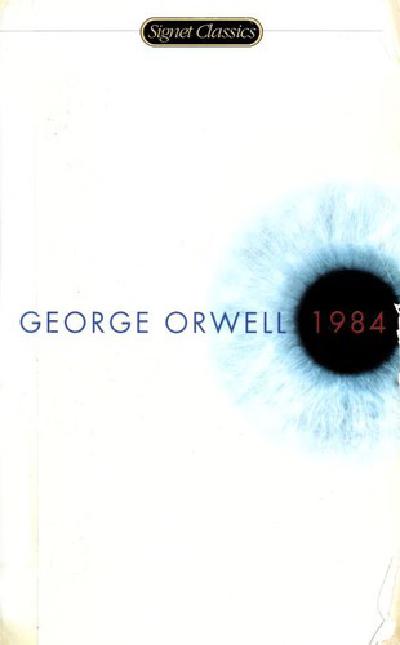
So, I finally got around to reading 1984. I know, I’m like a decade late to the party—everyone’s been talking about “Big Brother” since they were in middle school—but I figured it was time to actually dive in instead of just using the references in arguments. And man… where do I even start? Reading this book isn’t exactly a “relaxing weekend activity.” It’s more like a slow-motion car crash where you can see the wall coming, but you’re strapped into the seat and can’t even scream.
The first thing that hit me wasn’t the politics or the “scary government” stuff. It was the smell. Orwell does this thing where he describes the world as just… gross. Everything smells like boiled cabbage and old rag mats. The gin tastes like something that should be used to strip paint off a fence. And that’s actually the genius of it. He doesn’t start by telling you that the government is evil; he starts by showing you a world that just fundamentally sucks. It’s that kind of gray, depressing atmosphere where you’re just perpetually tired and slightly hungry. I found myself actually feeling claustrophobic just reading the descriptions. It’s like the book is trying to make you feel as exhausted as Winston is, so that by the time the real horror starts, you’re already worn down.
Then there’s the whole “Newspeak” thing. I’ve always heard about it, but seeing it in action is a totally different vibe. The idea that the government is literally deleting words from the dictionary so that people can’t even think about rebellion? That is genuinely the scariest part of the book. Like, think about it. If you don’t have a word for “freedom,” do you even feel the itch to be free? Or do you just feel a vague, nameless discomfort that you can’t explain? It made me look at my own vocabulary and wonder how much of the way I think is just a result of the words I happen to know. It’s a trip. It turns the book from a “scary story about a dictator” into a “scary story about how your own brain can be hacked.”
And then we get to Winston. Poor, miserable Winston. I actually felt for the guy, which is weird because he’s not exactly a “hero” in the traditional sense. He’s just a guy who’s tired of lying. The moment he buys that diary? I was actually stressed for him. The way Orwell describes that first act of rebellion—just writing “Down with Big Brother” over and over—it felt like watching someone walk a tightrope over a pit of sharks. You know he’s going to fall; you just don’t know when the snap is going to happen.
The relationship with Julia was the only part where I felt like I could breathe. It wasn’t even a “romance” in the way we usually think about it. It was more like two people clinging to each other in a shipwreck. Their “love” was basically a middle finger to the state. I loved how they didn’t even really like each other at first—they just both hated the Party. It felt so much more honest than some sweeping cinematic romance. It was just: “Hey, you hate this as much as I do? Cool, let’s go hide in a room above a junk shop and eat real chocolate.” It gave me a tiny bit of hope, which, knowing how this book ends, was a cruel trick by Orwell.
Speaking of the ending… wow. Just… wow. I knew it wasn’t going to be a “happily ever after,” but the way the Party breaks Winston is just brutal. The scenes in the Ministry of Love are honestly hard to read. It’s not even about the physical torture—though that’s bad enough—it’s the psychological dismantling. When O’Brien starts talking about “2 + 2 = 5,” it’s not a math problem. It’s a test of: “Will you trust your own eyes, or will you trust me?” And the terror of realizing that the state can eventually make you believe something that is obviously false just because they have the power to make you suffer is… it’s a void.
And Room 101. I don’t even want to talk about the rats. The moment Winston screams “Do it to Julia!” I felt a physical knot in my stomach. That is the ultimate betrayal. The Party didn’t just kill him; they took the one thing he had left—his loyalty to another human being—and they turned it into a weapon against him. By the time he’s sitting in that cafe at the end, staring up at the poster of Big Brother and realizing he loves him… it’s just devastating. There’s no redemption. No secret rebellion. Just a hollowed-out man.
I will say, there were a few parts that felt like a bit of a slog. Specifically, that rest of the book where Winston reads “The Theory and Practice of Oligarchical Collectivism.” Like, I get it, the world-building is important, and the explanation of how the war works is fascinating, but man, it felt like I was reading a political science textbook for about forty pages. I almost skimmed it because I just wanted to get back to the tension of Winston and Julia’s secret life. It’s a bit of a speed bump in an otherwise gripping story.
But looking at it now, in 2026? It feels way too relevant. We don’t have “telescreens” bolted to our walls, but we have smartphones that track our location, listen to our conversations, and feed us a curated version of reality through algorithms. We aren’t being forced to believe “2 + 2 = 5” by a guy in a torture chamber, but we’re often nudged into it by echo chambers and “alternative facts” online. We’ve basically built our own Ministry of Truth, but we did it voluntarily because the UI is pretty and we get to see cat videos. It’s a different kind of control, but the end result—the erosion of objective truth—is exactly what Orwell was warning us about.
Anyway, if you haven’t read it, you absolutely should. Just… maybe have some something happy to watch afterwards, like a sitcom or a cartoon, because this book will leave you staring at your ceiling at 3 AM wondering if your toaster is reporting your thoughts to the government. It’s a masterpiece, but it’s a masterpiece that leaves you feeling like you need a shower and a very long nap.
The Quick Rundown
What I loved:
- The atmosphere. I could practically smell the boiled cabbage.
- The psychological horror. The “hacking the brain” aspect is way scarier than any monster movie.
- The absolute lack of mercy in the ending. It makes the warning feel real.
What I struggled with:
- The “textbook” sections. A bit too much exposition in the middle.
- The sheer bleakness. It’s a heavy lift emotionally.
The Verdict: Read it. Seriously. It’s a haunting, visceral experience that makes you value your own mind and your own privacy in a way that nothing else does. Just don’t expect to feel “good” after you finish it.